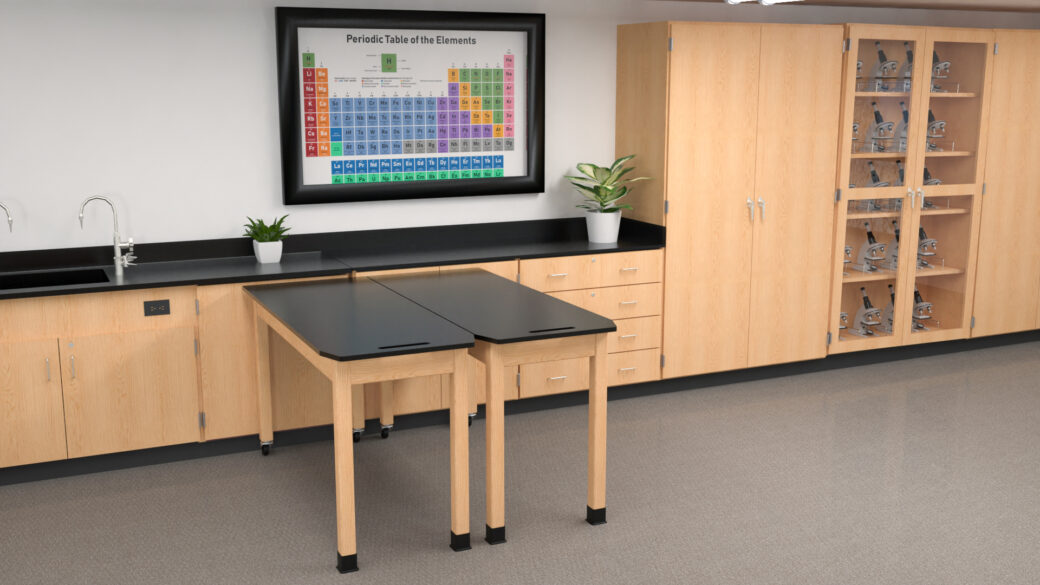

Science Classrooms Are Evolving.
Flexible learning environments have been shown to improve student engagement and collaboration—but only when the space can adapt quickly. That’s where many labs fall short.
Students shift from independent work to group experiments. Teachers reconfigure layouts throughout the day. But traditional phenolic lab tables are heavy, difficult to move and often require two people to reposition.
So how do you design a science classroom that actually supports the way teachers teach?
Start with Furniture That Supports Movement
In many classrooms, moving a science table is a two-person job. That slows everything down.
The PerpetuLab Wheelbarrow Science Table was designed to change that. With a built-in pass-through handle and a 5-inch chamfered edge ergonomically designed for easy lift, it provides the leverage needed for controlled lift-and-roll movement.
That means one person can reposition the table safely—no dragging, no waiting for help.
What Is a Mobile Science Table?
A mobile science table is a lab table designed to be safely repositioned by one person without sacrificing durability or stability.
Unlike traditional stationary tables, mobile options allow classrooms to shift layouts quickly – supporting group work, demonstrations and hands-on learning without disruption.
This flexibility is becoming essential in modern science classroom furniture design.
Designed for Real Classroom Use.
Mobility only matters if the table can handle daily use.
That’s why the tabletop is constructed from 3/4-inch phenolic, delivering the durability expected in science labs.
It stands up to:
-
- Hands-on experiments
- Chemical exposure
- Daily classroom use
The table is also sized to work within existing environments – 24″ W x 60″ D x 33-1/2″ H – and is designed to fit under standard casework countertops.
Movement When You Need It. Stability When You Don’t.
Flexibility doesn’t mean sacrificing stability.
The table includes:
-
- Two 3-inch swivel locking casters
- Two glides with rubber boots
This allows for smooth movement when repositioning and a secure, stable surface during use.
Built for Science Classrooms
Every detail is designed with the classroom in mind. From the phenolic top to the Oak or Light Hardwood legs, this table is built to support daily instruction in active lab environments. Easy assembly means you can set this table up and use it quickly.
Image